Your cart is empty
Start ShoppingSearch FAQs
Found for ""
General Questions
Basic questions about hydrogen generators and the PureONE.
A hydrogen water generator, like the PureONE, is a device that produces hydrogen-enriched water through a process called electrolysis. The device splits water molecules (H2O) into hydrogen and oxygen gases using electricity and an electrolyte (sodium hydroxide).
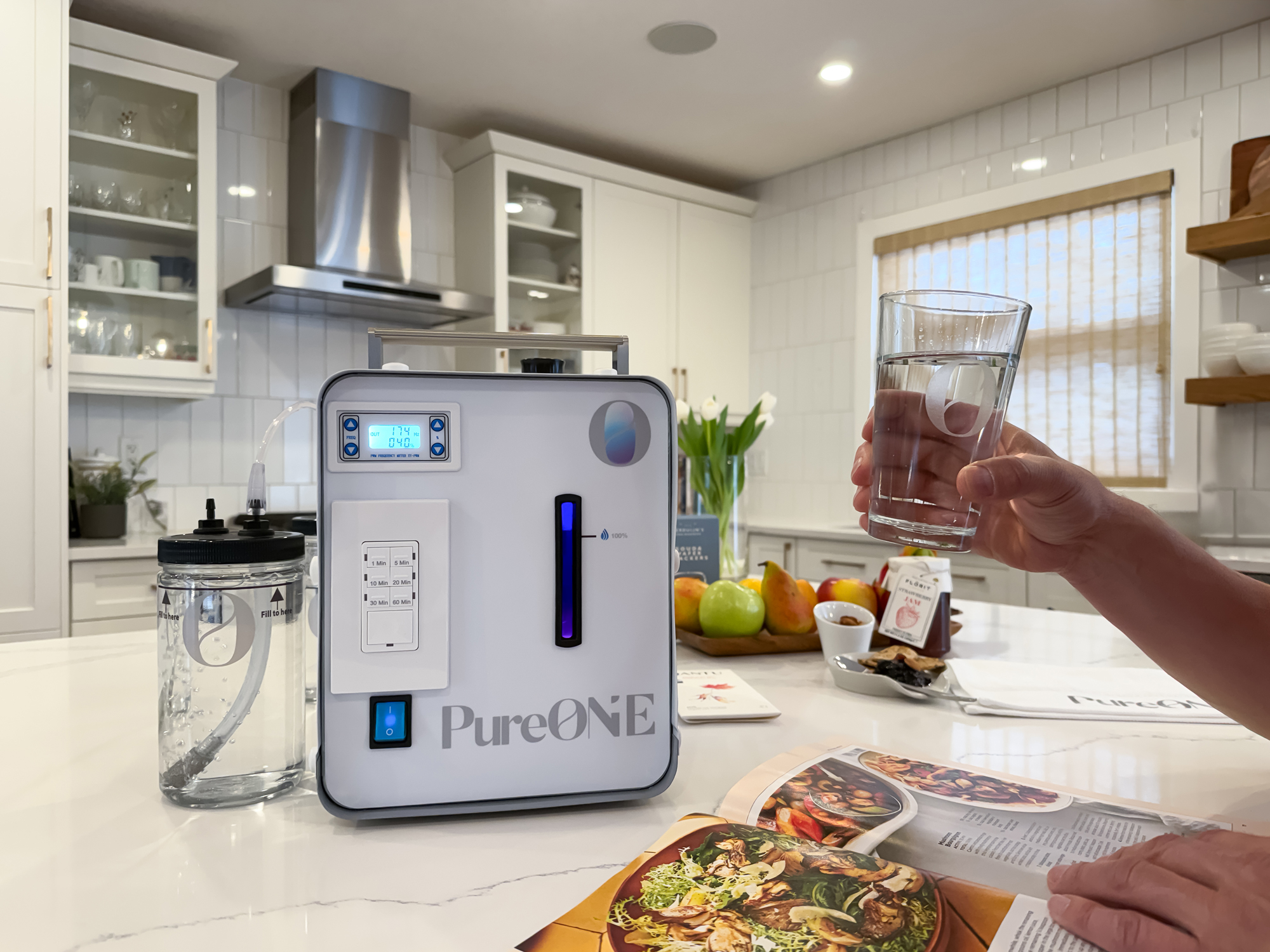
The PureONE specifically produces a 2:1 ratio of hydrogen to oxygen — known as HydrOxy or Brown’s gas. This gas can be inhaled directly through a nasal cannula, or bubbled into drinking water to create hydrogen-rich water.
About saturation levels:
- 1.6 ppm is the accepted saturation point for pure hydrogen dissolved in water at room temperature.
- Because the PureONE produces Brown’s gas (66% hydrogen), the practical maximum saturation at room temperature is about 1.2 ppm.
Daily Hydrogen’s PureONE represents the latest technology in hydrogen generation, providing safe and effective hydrogen production for home use.
Health & Wellness
Health-related questions (informational only).
Machine Maintenance
Questions about maintaining your hydrogen generator.
- Ground yourself before touching machine
- Ground the PureONE to earth ground
- Use anti-static mats in work area
- Maintain proper humidity (40-60%)
- Avoid synthetic clothing while operating
- Don't use machine during thunderstorms
- Connect ground wire to metal chassis
- Attach other end to proven earth ground
- Verify ground connection with multimeter (<1 ohm)
- Test grounding periodically
- Never operate without proper grounding for inhalation use
If you can't feel gas coming from the cannula, check these common issues:
- Clear kinked hose — straighten any bends or kinks in the tubing between the PureONE and the cannula.
- Verify timer settings — make sure the timer is on and the PureONE is actively producing gas.
- Check lid seals and hose connections — any gas leak upstream of the cannula will reduce or eliminate flow. Verify all bottle lids are tight and every hose is securely connected.
To confirm flow, place the cannula tips under water — you should see a continuous stream of small bubbles. If the test fails, work backwards through the system checking each connection.
Contact Daily Hydrogen support if the issue persists after these checks.
- Clear to Light Yellow: Fresh solution, optimal condition
- Brown and Cloudy: Normal when solution is poured out during maintenance - this is accumulated minerals from the electrodes
- Green: Contamination present, replace solution immediately
- Milky White: Possible water contamination
- Normal electrode mineral release over time
- Water quality issues
- Contamination from foreign substances
- Document all color changes
- Replace solution if green
- Contact Daily Hydrogen for unusual colors
- Never continue operation with contaminated solution
Machine Operation
Questions about day-to-day operation procedures.
No, never use tap, well, or spring water in your PureONE. These water sources contain minerals that will:
- Create harmful compounds during electrolysis
- Damage the electrodes permanently
- Produce toxic gases (chlorine, carbon monoxide)
- Void your warranty immediately
- Create safety hazards
The Requirement:
- Use only distilled water that reads at < 0.5 ppm on a TDS meter.
- Standard grocery-store distilled water generally meets this threshold — verify with a TDS meter if you have one.
Why Water Purity is Critical:
- Ensures safe gas production
- Protects the electrodes
- Maintains warranty coverage
- Prevents toxic gas formation
Daily Hydrogen cannot emphasize this enough: only use distilled water measuring < 0.5 ppm for safety and optimal performance.
Yes — any water can be used in the drinking water bubblers (infusion bottles). High pH well water is fine for bubbling your drinking water.
Important caveat: hydrogen makes the taste of contaminants in the water more pronounced. Depending on your palate, filtered water may be preferable for daily drinking. If the water tastes noticeably different after hydrogen infusion, try filtering it first.
Key distinction: this guidance is for the drinking water you bubble with hydrogen — not for the water that goes inside the PureONE itself. The machine always requires distilled water measuring < 0.5 ppm; no exceptions.
Daily Hydrogen recommends experimenting with different water sources for your drinking water to find the taste you prefer.
- Must be 99% pure sodium hydroxide (NaOH)
- No additives or anti-caking agents
- Food-grade or laboratory-grade preferred
- Avoid drain cleaner lye with additives
- Chemical supply companies
- Soap-making suppliers
- Online retailers (verify seller reputation)
- Some hardware stores (special order)
- Drain cleaners with added chemicals
- Products with unknown purity levels
- Any lye with additives or colorants
- Expired or improperly stored lye
- Check purity certificates
- Look for "99% pure" specification
- Verify it's sodium hydroxide (not potassium hydroxide)
- Machine still operates normally
- LED is purely cosmetic indicator
- Can be replaced if desired
- Does not affect gas production
- Power supply issue (check if machine produces gas)
- Wiring disconnection (requires service)
- Timer or electrical issue
- Verify machine is producing gas normally
- Check for bubbles in humidifier
- Confirm gas flows from cannula
- If gas production is normal, only LED issue
- No gas production AND no blue light
- Other electrical issues present
- Machine not functioning normally
The PureONE has a sight window that looks into the float reservoir with a purple indicator light inside. This light turns red when water needs to be added.
If you don’t see the purple light:
Most Common Cause – LED May Need Attention:
- The machine may still operate normally even without the indicator light
- The LED is primarily a visual indicator for water level
- Does not affect gas production
Other Possible Causes:
- Power supply issue (check if machine produces gas)
- Wiring disconnection (may require service)
- Timer or electrical issue
What to Check:
- Verify machine is producing gas normally
- Check for bubbles in the purifier bottles
- Confirm gas flows from cannula
- If gas production is normal, it may only be an LED issue
Important: When the light turns red, it indicates you should add distilled water. You can add 300 mL of distilled water to top up your PureONE when the red light appears.
Contact Daily Hydrogen if gas production is also affected.
Reduced gas production can have several causes:
Most Common — Low Lye Concentration:
Low lye concentration is indicated when you only get bubbling at higher duty% (more voltage is required to produce gas). If this is the case:
- Add 2 tablespoons of lye powder
- Mix with a small amount of distilled water first
- Allow 10 minutes for distribution
Other Causes to Check:
- Incorrect timer setting (verify proper setting)
- Voltage issues (ensure proper voltage: 110V or 220V)
- Electrode wear (rare, after years of use)
- Measurement error (remember: full output only at 100% setting)
Systematic Troubleshooting:
- Check lye concentration first — look for bubbling behavior at different duty% levels
- Verify timer and power settings
- Test with multimeter if needed
- Contact support if unresolved
Daily Hydrogen support can help diagnose performance issues and recommend solutions.
Understanding hydrogen concentration in water:
Saturation Explained:
1.6 ppm is the accepted saturation level for pure hydrogen dissolved in water at room temperature. However, the PureONE produces HydrOxy / Brown’s gas, which is approximately 66% hydrogen (the rest is oxygen).
Because the partial pressure of hydrogen in our gas is 66%, the maximum saturation you can achieve in water at room temperature is about 1.2 ppm of dissolved hydrogen. This is the practical ceiling for the PureONE.
Bubbling Time for Optimal Concentration:
It takes 20 minutes of bubbling at 100% duty to reach saturation for 1 liter of water (the volume of our infusion bottle).
Inhalation vs. Water Consumption:
- Inhalation delivers hydrogen directly to your system
- Blood saturation is achieved within 15-30 minutes of inhalation
- Once saturation is reached, additional hydrogen is simply exhaled
Important Note:
Higher isn’t necessarily better — once water reaches saturation, additional hydrogen simply escapes. The PureONE is designed to achieve optimal therapeutic levels efficiently.
Daily Hydrogen’s PureONE achieves effective hydrogen concentrations for both water infusion and inhalation therapy.
Machine Support
Technical support questions about machine operation.
- Crystallization, which may clog small internal passages
- Increased foaming, leading to unwanted lye carryover
- Corrosion risks and maintenance challenges
- Safety hazards from overly caustic solutions
- Inhalation of 100% gas output is extremely dangerous
- Any air mixture containing more than 4% hydrogen is explosive
- Most clinical studies use 2% hydrogen in air for beneficial effects
- For average adults, more than 18 lph may exceed the 4% safety limit
- Once blood is saturated with hydrogen, additional hydrogen is simply exhaled
- Higher concentrations don't improve benefits
- Safety must always be the priority
- Chemical supply companies
- Soap-making suppliers
- Online retailers (Amazon, eBay)
- Some hardware stores (special order)
- Daily Hydrogen (for convenience)
- Must be 99% pure sodium hydroxide
- No additives or anti-caking agents
- Food-grade or laboratory-grade preferred
- Avoid drain cleaner lye with additives
We recommend that the lye solution be changed once per year.
Why Annual Replacement:
Distilled water isn’t perfectly pure, so every addition of distilled water to top up your PureONE adds more trace impurities to the lye solution. Over time, these impurities can accumulate.
If You Need to Add More Lye Within a Year:
It’s not too likely that you’ll need to add more lye within a year, but it might still happen. If gas production drops noticeably:
- Add 2 tablespoons of lye powder
- Mix the lye with a small amount of distilled water first
- Add slowly to the machine while it’s off
- Wait 10 minutes before restarting
Signs You May Need More Lye:
- Low lye concentration is indicated when you only get bubbling at higher duty% (more voltage required to produce gas)
- Gas production has dropped noticeably
- No gas leaks or hose blockages present
If you notice reduced gas output, always check your purifier bottles and hose connections for leaks first before assuming it’s a lye issue.
Daily Hydrogen recommends keeping usage logs to track maintenance timing.
We recommend consuming hydrogen water within 12 hours for best results.
Why 12 Hours Maximum:
According to the Molecular Hydrogen Institute, it’s very difficult to fully prevent hydrogen from diffusing through containers. There is generally no measurable hydrogen remaining after 12 hours, even in sealed containers.
Recommended Containers for Infused Drinking Water:
- Glass containers with tight seals — safe for storing hydrogen-infused drinking water
- Food-grade plastic containers (BPA-free)
- Stainless steel containers with tight seals
Storage Tips:
- Fill containers completely to minimize air space
- Seal tightly immediately after filling
- Store in a cool, dark place — refrigeration helps retain hydrogen longer
- Best practice: drink soon after production
Daily Hydrogen can recommend specific storage containers designed for hydrogen water.
Yes, standard distilled water from any grocery store is perfectly adequate for the PureONE — as long as it measures at < 0.5 ppm on a TDS meter.
Acceptable Water:
- Distilled water reading < 0.5 ppm TDS (preferred)
Never Use:
- Tap water (contains minerals and chemicals)
- Well water (mineral content varies)
- Spring water (contains natural minerals)
- Alkaline water (can damage equipment)
- Water with any additives or minerals
Why Water Purity Matters:
- Pure water ensures safe gas production
- Prevents toxic gas formation
- Protects electrodes from damage
- Maintains warranty coverage
- Extends machine lifespan
Daily Hydrogen emphasizes that water purity directly affects safety and performance.
Maintenance & Troubleshooting
Questions about maintenance and problem solving.
The most common cause is a gas leak. This can happen where the lids seal to the bottles, or where the hoses connect.
First, check for gas leaks:
- Inspect each bottle lid seal — make sure the lid is properly tightened and the seal is seated correctly
- Check every hose connection — loose fittings are a common culprit
- Inspect the pressure release on the first purifier bottle — it shouldn’t be leaking
- If one bottle is bubbling but the next isn’t, gas is escaping between them — check that lid’s seal and hose connection
If no leaks are found, also check:
- Power is on and the timer is running
- Water level is correct (not overfilled, not low)
- Fuse is intact
If the issue persists after checking all of the above, contact Daily Hydrogen support.
Regular cleaning keeps your PureONE running reliably.
Weekly:
- Wipe down the exterior with a damp cloth (no harsh chemicals)
- Check the purifier bottles and top up with distilled water as needed
- Inspect hoses for kinks or wear
Annually (deep clean):
- Drain the lye solution and perform the maintenance rinse procedure (see the support article for step-by-step instructions)
- Refill with a fresh lye solution
Never use soap or detergents inside the unit — they contaminate the system and can cause issues with gas production.
Daily Hydrogen provides detailed cleaning instructions and recommends appropriate cleaning supplies.
It’s normal for the lye solution to change color over time. Here’s what different colors indicate:
Normal Colors (No Action Needed):
- Clear: Normal — fresh solution
- Yellow: Normal — no action needed
- Green: Normal — same as yellow or clear, it’s safe
Colors That Need Attention:
- Brown and cloudy: Indicates a buildup of byproduct. Your PureONE may be due for cleaning. This is also normal when solution is poured out during annual maintenance.
- Milky white: Likely indicates soap contamination. The solution may need to be replaced and the system thoroughly cleaned.
What to Do:
- If you see brown/cloudy: follow the maintenance rinse procedure and consider changing the lye solution
- If you see milky white: drain the solution, thoroughly clean the system, and prepare a fresh electrolyte solution
Daily Hydrogen support can help interpret any unusual conditions in your PureONE.
We recommend that the lye solution is replaced once per year.
Why annual replacement:
Distilled water isn’t perfectly pure, so trace contamination is added to the electrolyser every time distilled water is added to the machine. These trace impurities accumulate in the lye solution over time. Replacing the lye solution annually will ensure that your distilled water remains contaminant-free.
Signs the solution needs changing:
- Brown or cloudy appearance
- Decreased gas production that doesn’t respond to adding more lye
- It’s been over a year since the last complete change
How to change the solution:
- Safely drain the old solution (follow proper lye handling procedures — see the Maintenance Rinse Procedure support article)
- Rinse the system with distilled water
- Prepare a fresh electrolyte solution following the setup instructions
Daily Hydrogen provides guidance on proper lye handling and solution preparation.
Purchasing & Warranty
Questions about buying, returns, and warranty.
Your PureONE includes comprehensive warranty coverage for parts, labor, and technical support.
Important: Registration is NOT Required
You do not need to register your PureONE for warranty coverage. We match the serial number to your order to determine warranty eligibility. This is also true for returns.
Warranty Coverage Includes:
- Parts warranty
- Labor warranty
- Technical support
What’s Covered:
The warranty covers manufacturing defects and component failures under normal use.
What’s Not Covered:
- Damage from misuse
- Unauthorized modifications
- Normal wear items
Daily Hydrogen stands behind every PureONE with comprehensive warranty coverage. Contact us with your serial number for any warranty inquiries.
Your PureONE comes complete with everything you need to start producing hydrogen water immediately:
Included Items:
- Main generator unit
- Power cord (voltage-specific for your region)
- Two Purifier Bottles
- Infusing Bottle (for bubbling drinking water)
- Nasal cannula set
- Connection hoses
- 80g lye starter pack
- Measuring tools
- Spot applicator
- Eye Treatment Goggles
Documentation:
Complete documentation and instructions are available on our website for your reference.
Daily Hydrogen provides everything needed for immediate operation with your PureONE purchase.
Yes — any generator can be returned for a refund within 365 days of purchase.
To initiate a return:
Contact our support team to discuss your specific situation. Daily Hydrogen works with customers to address any concerns about their PureONE purchase.
Warranty claims:
Warranty claims for defective units are handled separately and are automatically linked to your serial number and order.
Daily Hydrogen is committed to customer satisfaction.
Contact Daily Hydrogen to discuss available payment options. We strive to make the PureONE accessible and may offer various payment solutions depending on your needs and qualifications.
Daily Hydrogen is committed to making the PureONE accessible to all interested customers.
Safety Questions
Safety-related questions and concerns.
Yes, hydrogen water produced by the PureONE is safe to drink when the device is used according to instructions.
About Hydrogen Concentration:
The PureONE produces approximately 1.2 ppm of hydrogen dissolved in water. This is the saturation level for Brown’s gas (which is 66% hydrogen by partial pressure) at room temperature.
Safety Information:
- Hydrogen gas dissolved in water is non-toxic
- Hydrogen naturally occurs in small amounts in regular water
- The concentration achieved by the PureONE is well within safe limits
Important Note:
The PureONE is sold for experimental and research purposes. Users should consult healthcare providers for medical advice.
Daily Hydrogen provides comprehensive safety guidelines with every PureONE purchase.
Inhaling hydrogen gas through the PureONE is considered safe when you follow the safety guidelines.
Key safety points:
- Keep flow rates at recommended levels (never exceed 18 lph for adults; 4-9 lph for children)
- Always use nasal cannulas (never masks)
- Ensure adequate airflow in the room
About hydrogen concentration:
The 2% in-lung hydrogen concentration achieved at these flow rates is well below the explosive limit and has been used safely by thousands of users. There is no strict time limit on inhalation sessions once the body has adjusted to hydrogen — use for as long as is comfortable.
Always consult your healthcare provider before beginning any new wellness routine.
Daily Hydrogen provides detailed safety protocols and training for all PureONE users.
Inhaling hydroxy gas through the PureONE is considered safe when following proper guidelines.
Duration:
It’s safe to inhale the gas for as long as you want. Some people inhale overnight while they sleep. We’ve even heard of people inhaling for 18 hours per day.
Important Consideration – Detox Symptoms:
Hydrogen can cause detox symptoms as the body adjusts to the presence of hydrogen. Some people may need to start with shorter sessions. Common adjustment symptoms may include:
- Mild headaches
- Fatigue
- Other temporary sensations
Recommended Approach:
- Start with shorter sessions if you’re new to hydrogen therapy
- Gradually increase session length as your body adjusts
- Once you can inhale for 20-30 minutes with no issues, you should be able to inhale as long as you want
Always:
- Use nasal cannulas (not masks)
- Ensure proper ventilation in your space
- Consult your healthcare provider before beginning any new wellness routine
Daily Hydrogen provides detailed safety protocols and training for all PureONE users.
The PureONE’s body is grounded through the ground wire in the power cord. No additional grounding is needed.
How it works:
The machine is automatically grounded when plugged into a properly grounded electrical outlet. The ground pin in the power plug provides the necessary grounding connection.
Static electricity:
If you have static buildup on your person, simply touching the metal body of the PureONE will safely discharge that static charge through the grounded connection.
Quick tips:
- Always use a properly grounded electrical outlet
- Touch the PureONE to discharge personal static before a session
Daily Hydrogen recommends using properly grounded outlets for safe operation.
There is no specific toxicity associated with inhaling hydrogen gas from the PureONE at normal usage levels.
What You Might Experience:
- Throat/Lung Irritation: High concentrations may bother the throat and lungs for some people
- Dizziness: This typically comes from how a person inhales, not necessarily how much or how long. If you’re focusing on very deep breaths (essentially hyperventilating), you may become dizzy – this would happen with plain air too.
- Detox Symptoms: These can cause various sensations as your body adjusts to hydrogen. This is normal and temporary.
Recommendations:
- If you experience any discomfort, reduce your treatment times
- Continue with shorter sessions until you no longer experience detox symptoms
- Once you can inhale for 20-30 minutes with no issue, you should be able to inhale as long as you want with no issue
- Breathe normally – avoid hyperventilating or forcing deep breaths
Daily Hydrogen emphasizes the importance of listening to your body and adjusting accordingly.
Technical & Usage
Technical questions about operation and usage.
Hydrogen gas begins escaping from water immediately after bubbling stops.
Retention Times:
- Uncovered container: Most of the hydrogen dissipates within 30-60 minutes
- Sealed and kept cold: Up to 12 hours
According to the Molecular Hydrogen Institute, it’s very difficult to fully prevent hydrogen from diffusing through containers — even sealed, refrigerated hydrogen water has generally lost all measurable hydrogen within 12 hours.
Best Practice:
For optimal hydrogen content, drink the water immediately after production. If you need to store it, seal tightly and refrigerate.
Daily Hydrogen provides storage recommendations and containers designed to maximize hydrogen retention.
The PureONE produces hydrogen water with a maximum concentration of approximately 1.2 ppm at room temperature — the saturation point for Brown’s gas. (1.6 ppm is the saturation for pure hydrogen, which is not what the PureONE produces.)
Studied range:
Research studies on hydrogen water generally use concentrations between 0.5 ppm and the saturation point. Current research shows no measurable benefit to hydrogen water below 0.5 ppm, so aim to stay above that level.
How long to bubble:
Higher isn’t necessarily better — once water reaches saturation, additional hydrogen simply escapes. The PureONE reaches full saturation in about 20 minutes per liter at 100% gas production.
Daily Hydrogen’s PureONE is designed to achieve optimal hydrogen concentrations efficiently.
No. We only recommend using distilled water that measures at < 0.5 ppm on a TDS meter.
Water Requirements:
- Use ONLY distilled water
- The distilled water should read < 0.5 ppm TDS
- Do NOT use reverse osmosis water
- Do NOT use deionized water
- Do NOT use any other type of purified water
Why This Matters:
Tap water contains minerals that can create toxic gases during electrolysis. Using improper water can also:
- Damage the electrodes permanently
- Create potentially dangerous compounds
- Void your warranty
- Reduce the lifespan of your device
Where to Get Distilled Water:
Standard distilled water from any grocery store is generally adequate. Verify it reads < 0.5 ppm if you have a TDS meter.
Daily Hydrogen strongly emphasizes using only distilled water for safety and optimal performance.
Check water levels before each use. Depending on usage, you’ll typically need to add distilled water periodically.
When to Add Water:
When the red light comes on, you can add 300 mL of distilled water to top up your PureONE.
General Guidelines:
- Check water levels daily before use
- The PureONE consumes water during the electrolysis process
- Depending on usage, expect to add water every 20-40 hours of operation
- Never let the water level drop below the minimum mark
- Always maintain levels between the MIN and MAX indicators
Important:
- Only add distilled water (0.5 ppm TDS or below)
- The indicator light will turn red when water needs to be added
Daily Hydrogen recommends establishing a routine for checking and maintaining proper water levels.